
Retirement Income Planning
The 20,000-Foot View of Your Retirement
Income, taxes, Medicare, inflation and your investments, all in one clear plan for the rest of your life.
The question behind every retirement
"Will My Money Last?"
You spent decades saving. Now the job changes. Instead of a paycheck from work, you need a paycheck from everything you have built: Social Security, pensions, annuities and your investments.
There are a lot of moving parts. We put them all into one plan, then show you the answer in plain English.
What goes into your plan
We Look at the Whole Picture
Most retirement estimates look at one or two numbers. Ours looks at twelve.
Social Security
When each of you claims, and yearly cost-of-living raises.
Pensions
Monthly pension income and survivor options.
Annuities
Guaranteed income you already own or may add.
Investments
IRAs, 401(k)s, Roth and taxable accounts.
Your expenses
What life actually costs you, today and later.
Inflation
Prices rise every year. Your plan has to keep up.
Taxes
Your tax bracket and filing status, single or married.
Medicare and IRMAA
Part B and D premiums, plus surcharges if income runs high.
Life expectancy
We plan well into your 90s, for both of you.
Your timeline
Still working? When each of you plans to stop.
Savings rate
What you are still adding before you retire.
Required withdrawals
RMDs the IRS makes you take, and the taxes they trigger.
Your Retirement Paycheck
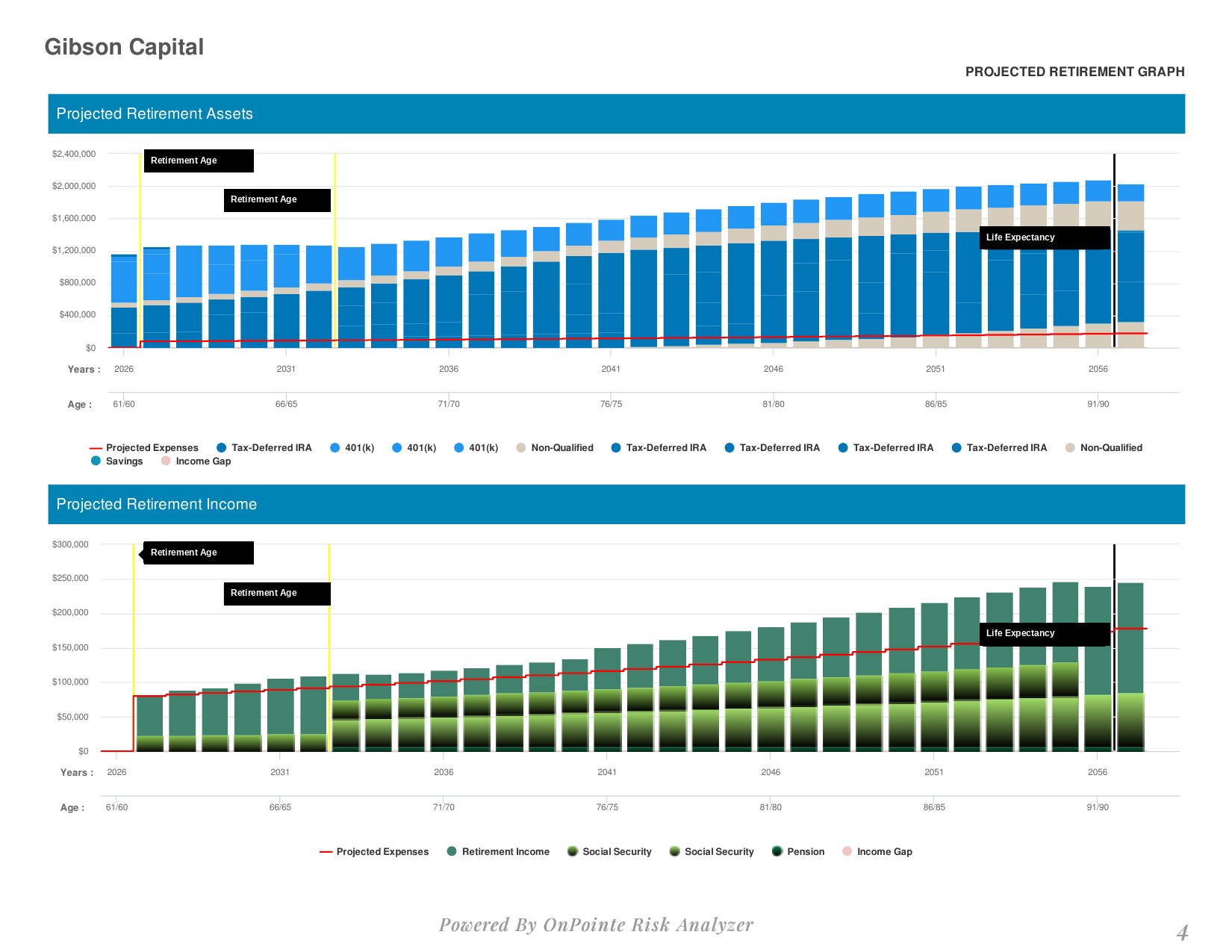
Every bar is one year of your retirement. The colors show where that year's income comes from.
In the early years, more comes from your investments. Later, Social Security, pensions and annuity income carry more of the load.
The dotted line is your spending. It climbs every year because of inflation. The goal is simple: the bars stay at or above the line.
What you get
Your Personal Retirement Report
You leave with a written report built around your life, not a rule of thumb.
- Year-by-year income and expenses from the day you retire through your 90s.
- Where each dollar comes from and which accounts to draw from first.
- Your estimated federal and state taxes each year, including your tax bracket in retirement.
- Medicare Part B and D costs, and whether IRMAA surcharges may apply.
- Required minimum distributions and when they begin.
- A Roth conversion check to see if converting makes sense for you. Learn more about our tax strategies.
Will My Income Last as Long as I Do?
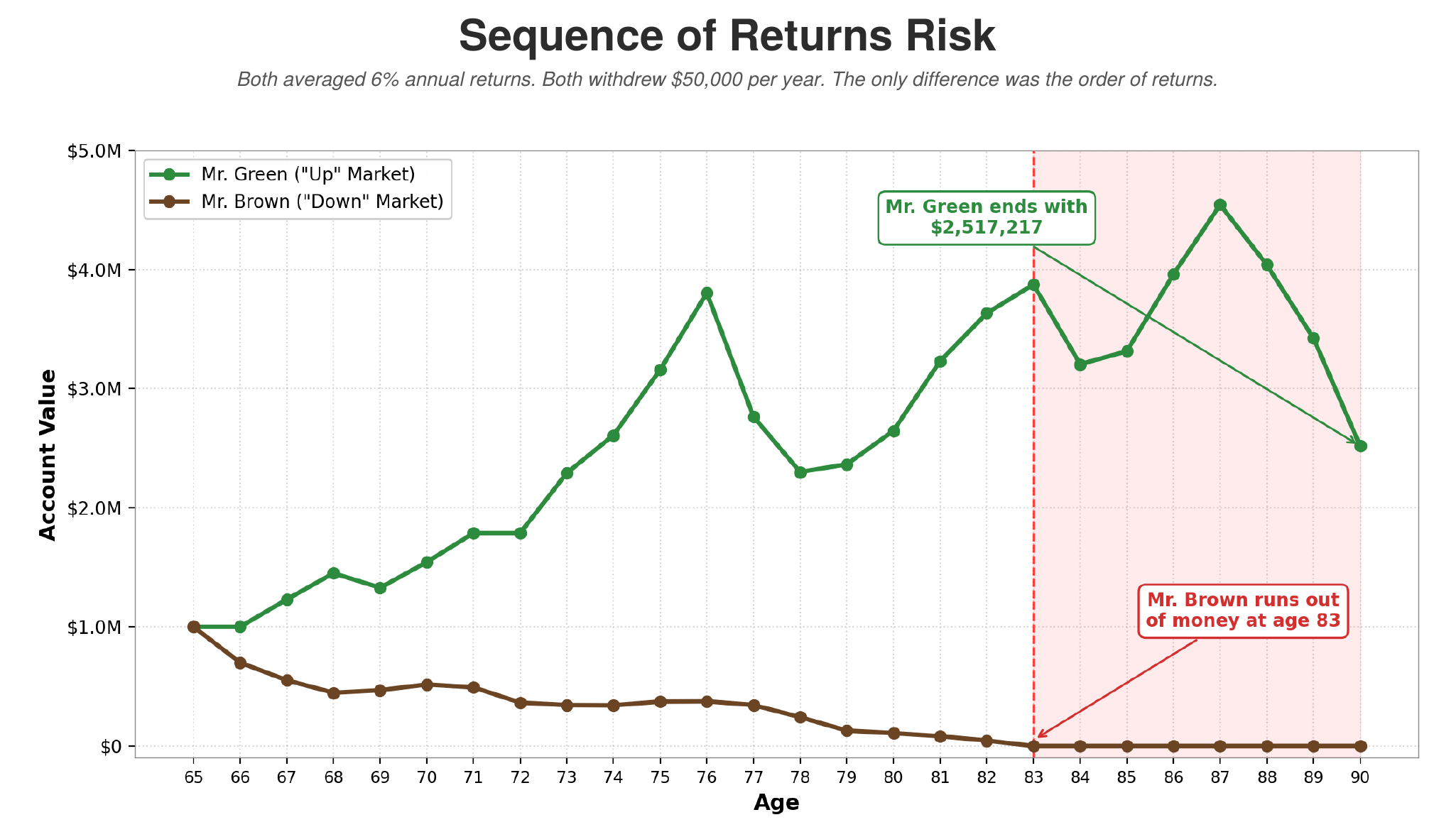
Meet Mr. Green and Mr. Brown. They retire with the same savings. They take out the same amount every year. Over 25 years they earn the same average return.
The only difference is the order. Mr. Green gets the good years first. Mr. Brown gets the bad years first.
Mr. Green still has plenty at 90. Mr. Brown runs out at 83.
That is called sequence of returns risk. A drop early in retirement hurts far more than the same drop later, because you are taking money out at the same time. It is why we stress test every plan against a bad start.
How we run the numbers
Realistic, Not Rosy
It is easy to make a retirement plan look good. Just assume the market always goes up. We do the opposite. We tone the numbers down on purpose, so your plan is built on what is likely and not on what is hoped for.
Modest growth assumptions
We are not shooting for the moon. We use conservative return estimates over the next 20, 30 and 40 years.
Market risk
Markets fall. We test how your plan holds up when they do.
Sequence of returns risk
We test a bad market in the first years of retirement, when it can do the most damage.
Rising costs
Groceries, travel and health care all cost more over time. Your plan grows your income to match.
A long life
Running out of money at 85 is not a plan. We carry the numbers into your 90s.
Taxes and Medicare
We estimate your federal and state taxes and your Medicare premiums every year, so there are fewer surprises.
How it works
Four Simple Steps
01
Share
Tell us about your accounts, income, spending and when you want to retire.
02
Build
We build your plan using realistic assumptions.
03
Test
We stress test it against bad markets, inflation and a long life.
04
Review
We walk you through it in plain English and update it as life changes.
Your Questions, Answered
What is retirement income planning?
It is a plan for turning your savings into steady income. It shows how much you can spend, where the money comes from each year, and how long it is expected to last.
What do I need to bring?
Recent statements for your retirement and investment accounts, your Social Security estimate, any pension or annuity details, and a rough idea of what you spend each month. We help you with the rest.
What if I am still working?
That is the best time to start. The plan includes your current income, what you are still saving, and the retirement date for you and your spouse.
What is sequence of returns risk?
It is the risk of a market drop early in retirement. Because you are withdrawing money at the same time, early losses are harder to recover from. We test for it in every plan.
What is IRMAA?
IRMAA is an extra charge added to Medicare Part B and Part D premiums when your income is above certain levels. We project it so you can plan around it.
How often is my plan updated?
We review it at least once a year, and any time something big changes, such as retiring, selling a home or losing a spouse.
Is the plan a guarantee?
No. A plan is a projection based on assumptions, and real life will differ. That is why we use conservative numbers and update the plan regularly.
Projections are hypothetical, are based on assumptions that may not come true, and are not guarantees of future results. Investing involves risk, including the possible loss of principal. Gibson Capital does not provide tax or legal advice. Please consult your tax professional.
See Your Own 20,000-Foot View
Schedule a conversation and we will build your personal retirement income report.